Showing posts with label Research. Show all posts
Showing posts with label Research. Show all posts
Friday, 2 March 2018

Thursday, 1 March 2018


Wednesday, 7 February 2018
Thursday, 11 January 2018
Sunday, 3 December 2017
Film Review - Edward Scissorhands
The poignant yet heart warming story of Edward Scissorhands was created in 1990 by Tim Burton. It follows Peg Boggs, who discovers Edward Scissorhands in a derelict castle, where the scientist who was in the process of creating him had passed away before he could finish what he had started. As a result of this, Edward is stuck with scissors for hands. Peg takes pity on him and brings him to her home, which starts a flurry of interest and drama in the neighbourhood where she resides with her family. Eventually, after causing so much trouble, Edward decides it is best for him to go back to where he belongs: back to his castle on his own. This story is all told by an old woman to her grand daughter, who is explaining where the snow comes from: every winter, Edward makes ice sculptures up in his castle, and the snow is made whilst he works.
 |
| Fig. 1 |
Tim Burton's vision comes to life in an "entirely artificial world, where a haunting gothic castle crouches on a mountaintop high above a storybook suburb, a goofy sitcom neighborhood where all of the houses are shades of pastels" (Ebert, 1990). The deliberate stylization of the houses that are all different colours, but essentially the same house replicated over and over, shows Burton's views on society: how everyone is trying to be different, but in fact, people are exactly the same. This is especially true when you study how Hollywood as a society works. Films are remade and reused over and over, and are just slightly revamped to try and make it 'new' and 'exciting'. In fact, it's just the same movie, and the creators are only interested in making money. Tim Burton dares to be different, combining the typical suburbian community and architecture, with a gothic, introverted character who doesn't exactly fit in.
 |
| Fig. 2 |
Although he is chased out of the dull town in the end for being too different, "it's Edward who eradicates the blandness by sculpting the town's hedges into exotic topiaries of animals and people." (Travers, 1990). However, Burton shows how lethal it is to be different in a society full of people who are conforming to strict social standards. Any kind of creativity and difference is crushed and chased away, and Burton shows this clearly as poor Edward has to run from dozens of angry people for being misunderstood.
 |
| Fig. 3 |
Edward Scissorhands isn't only a good story, it also has "stunning cinematography, art design, costume design and production values." (Propes, no date). Burton's use of set design to show the stark contrast between Edward and the other 'normal' characters is amazing, and the music adds to the emotion in the film, encouraging the viewers to really sympathise with Edward and feel for the innocent person that has been thrust into this crazy world that has strict guidelines that Edward just can't keep to, leaving him just how he was at the beginning of the film: alone.
Bibliography
Ebert, R (1990). "Edward Scissorhands" in Roger Ebert [online]. Available at: https://www.rogerebert.com/reviews/edward-scissorhands-1990
Propes, R (no date). "Edward Scissorhands Review" in The Independent Critic [online]. Available at: http://theindependentcritic.com/edward_scissorhands
Travers, P (1990). "Edward Scissorhands" in Rolling Stone [online]. Available at: http://www.rollingstone.com/movies/reviews/edward-scissorhands-19901214
Illustration List
Fig. 1 - https://upload.wikimedia.org/wikipedia/en/3/3b/Edwardscissorhandsposter.JPG
Fig. 2 - http://anotherimg.dazedgroup.netdna-cdn.com/1050/azure/another-prod/350/0/350191.jpg
Fig. 3 - http://crypticrock.com/~crypti10/dev/wp-content/uploads/2015/12/Edward-Scissorhands-21.jpg
Film Review - La Belle et La Bete
La Belle et La Bete is a French film released in 1946. Written by Jean Cocteau, it is the original Beauty and The Beast, so the story is similar: a young girl takes her father's place as prisoner in a castle with a beast. The film has a surreal mix of elements in the set design, including hands holding candlesticks on the walls and statues that move. What makes La Belle et La Bete even more of an achievement is that all of the effects in the film were done without the use of any technology, instead relying on the skills of makeup artists, set design and costume.
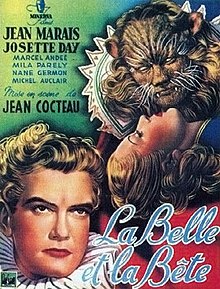 |
| Fig. 1 |
Much different from the more modern films, "Cocteau uses haunting images and bold Freudian symbols to suggest that emotions are at a boil in the subconscious of his characters." (Ebert, 1999). You can see just how much thought has been put into the set design, from the extravagant costumes to the elegant castle at The Beast resides in. Symbolism is used throughout the film to covey the thoughts of the characters, like spilled pearls or knives which are more than just an object: they have completely different meanings, and certainly shouldn't be taken at face value.
 |
| Fig. 2 |
Despite the erotic connotations throughout the film, there is still the strong sense of fantasy and magic, something which is later replicated in the Disney film. Described as being full of "wonder and mystery" (Brooks, 2014), La Belle et La Bete transports the audience to another world, with magical objects, a huge and beautiful castle, and a heart-warming love story. This is something that the audience of 1946 would have wanted, after all, France has just been ravaged by the Nazis in WW2. This child-like theme continues throughout the film, not only through the beautiful cinematic shots, but the use of sound and music. Although the movie doesn't have a stereotypically 'happy' ending, it still leaves the viewer satisfied at the end of the story. Even though we don't know what will happen to Belle's family, or even Belle herself, there's something about Belle and The Beast just floating away before the end credits that leaves the audience feeling like the story is complete.
 |
| Fig, 3 |
The film is bold and simple, and Cocteau uses his skills to work on "weaving a priceless fabric of subtle images." (Crowther, 1947). La Belle et La Bete, despite its underlying sexual messages, is, at heart, a film about a woman falling in love with an unlikely suitor, full of fantastical props, a beautiful castle, and a story that transports the audience to another world.
Bibliography
Brooks, X (2014). "La Belle et la Bête – review" In The Guardian [online]. Available at: https://www.theguardian.com/film/2014/jan/05/la-belle-et-la-bete-remastered-cocteau-review
Crowther, B (1947). "THE SCREEN IN REVIEW" In The New York Times [online]. Available at: http://www.nytimes.com/movie/review?res=9B03EFD71E3EEE3BBC4C51DFB467838C659EDE
Ebert, R (1999). "Beauty and the Beast" In Roger Ebert [online]. Available at: https://www.rogerebert.com/reviews/great-movie-beauty-and-the-beast-1946
Illustration List
Fig. 1 - https://upload.wikimedia.org/wikipedia/en/thumb/a/a4/La_Belle_et_la_B%C3%AAte_film.jpg/220px-La_Belle_et_la_B%C3%AAte_film.jpg
Fig. 2 - https://brendancultfilms.files.wordpress.com/2011/12/screen-shot-2011-12-06-at-8-54-46-am.png
Fig. 3 - https://i.ytimg.com/vi/36MbmkriK2g/hqdefault.jpg
Friday, 10 November 2017
Toolkit - Animator Reviews
Lotte Reiniger
Lotte Reiniger was a German animation artist that specialised in the method of silouhette animation. She liked to base she animations on fairy tales and folk myths. Her work can be described as avant-garde: something new and experimental. She made over 40 films during her career.

As a child, Reiniger was interested in the Chinese art of silhouette puppetry, and built her own puppet theatre so she could make shows for her family and friends. In 1918 the success of her work got her into the Institute for Cultural Research, an experimental short film and animation studio. Here she met a lot of other avant-garde artists, as well as her creative partner and husband, Carl Koch. Reiniger directed her first film in 1919 and it was a big success, despite only being five minutes long. She made six more short films in the following years with her husband.
In 1923 she was asked to create a feature length film, which was a large proposal as nobody had made a short film longer than about 10 minutes before. The result of this proposal was The Adventures of Prince Achmed, which was completed in 1926. It became a critical and popular success. Following this success Reiniger made another feature called Doctor Dolittle and His Animals, which was completed in 1928.

Reiniger's style of animation was very unique and preceded Disney by 10 years. When she died in 1937, she left a lot of unfinished work, as well as a lot of inspiration for people to pull from in later decades. The fairy tale, childlike style of her animations are clearly reflected in Disney as well as lots of other early short films.
Don Hertzfelt
Don Hertzfelt was born in 1976 is an artist, writer, animator and film maker. His work commonly features hand drawn stick figures, some include heartfelt and existential themes whilst others are more light comedy. His animation is created traditionally on pen and paper, with minimal digital aid. He uses old-fashioned special effects, like using an old camera to capture his work and multiple exposures.
After graduating from school with a BA in Film Studies, he made numerous short films independently, from 2000 to 2015. His first one was called Rejected, released in theatres in 2000. It was a massive success and has won dozens of awards, as well as being nominated for an Oscar. In 2005, Hertzfelt released his next film, The Meaning of Life. Despite being a bit abstract it still received many positive reviews.

Everything Will Be Ok was released in 2006 and became Hertzfelt's most successful piece to date, and has won just under 40 awards. I Am So Proud of You was the second part to this story and was released in 2008, and the third and final chapter, It's Such a Beautiful Day, was released in 2011. He went on to publish more short films afterwards, as well as working on an opening sequence for The Simpsons. In 2015, Hertzfelt released his first digital short film called World of Tomorrow, which was hand drawn on a Cintiq tablet.
Hertzfelt's animations are very different to traditional methods, but still absurdly popular with audiences today. The old techniques he uses are essential to the whole feel and look of his films, as well as his adult humour.
Toolkit - Concept Art and Colour Theory
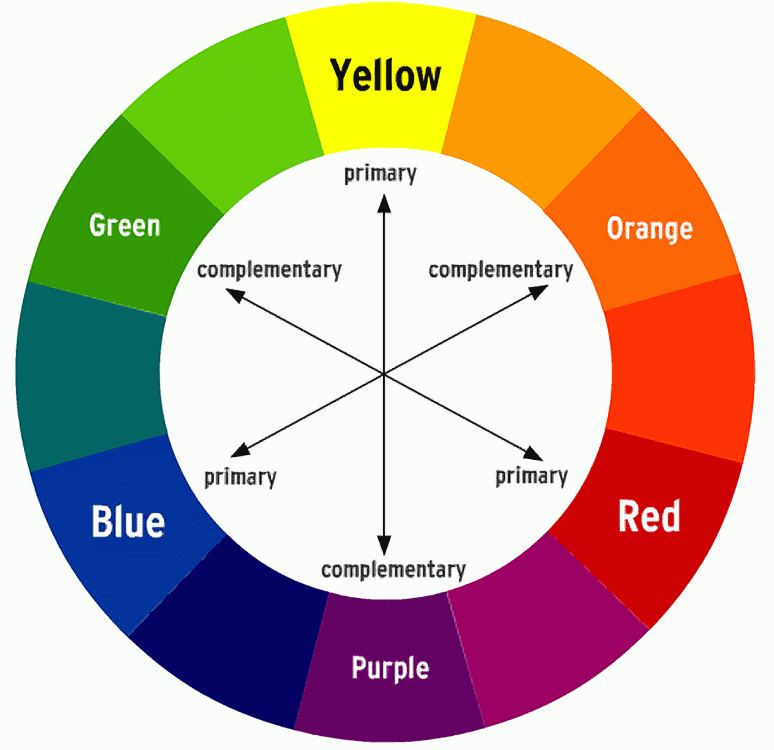
In Jordan's Photoshop class, we worked on some concept art for our cities. I drew out a few different designs which I have published in my last Invisible Cities post. As well as this, we went over colour theory, which was very interesting. I wanted to make a note on here of what we learnt about colour so I'll always have something to refer back to.
We learnt about the basic colour wheel, and we went over hues, tints, tones and shades. What interested me the most was how to pick your colours using different methods. You can pick your colours based on whether they are complementary or not. By doing this, you'll be able to make your art pieces pop a bit more: for example, if you have a red environment and use blue shadows, it'll look a lot more vibrant and interesting, compared to just using a darker red for the shadow (which is what I usually do!)
Wednesday, 1 November 2017
The 'What If?' Metropolis - Online Greenlight Review
Here is my OGR! I'm so pleased I managed to reach the required amount of thumbnails. It's crazy that I've managed to do 76 in just a week! I couldn't even reach 100 over the five weeks of Invisible Cities so it's such a big improvement. I didn't quite reach 1000 words on my travelogue, and I think it does need a bit more polishing. At least it gives a basic idea of what I want the city to be like. I've named the city Alptraum, which is German for 'nightmare', and I quite like the name, although I'm going to keep looking for better ones so it may change later!
Monday, 30 October 2017
The 'What If?' Metropolis - Updated Influence Map
I've been working on a small influence map to show the images that have been helping me out the most when making my thumbnails: I'm sure if you compare these pictures to my drawings you can see where a lot of them have come from! There's not really much in this presentation but I really wanted to compile some of Haeckel's art that I've found the most inspiring so far. Of course, I'm still using my previous inspiration maps throughout my thumbnails, but I'm now also using this one to give me a bit of an extra boost!
Thursday, 26 October 2017
Wednesday, 25 October 2017
Tuesday, 24 October 2017
The 'What If?' Metropolis - Ernst Haeckel
I'm going to start the ball rolling for the project with some research into the artist I've been given! I really like the look of Haeckel's work, and I love the idea of having an organically shaped city based on his art, as well as involving World War 1 influences to include relevant aspects of his life in the city.
Monday, 23 October 2017
Invisible Cities - Research
I completely forgot to upload this! Here is my research for Invisible Cities. As I'm more of a visual person, I decided to create small influence maps for each of the cities to enable me to explore them all.
Sunday, 22 October 2017
Who's Who? - Oscar Gregeborn
I hope this is a suitable concept artist presentation. I couldn't actually find much about Oscar Gregeborn online, which isn't much of a surprise as he's still very young. I found his art so inspiring I had to research him: even if there wasn't much information to go on!
Subscribe to:
Posts (Atom)