Friday, 10 November 2017

Toolkit - Animator Reviews

Lotte Reiniger

Lotte Reiniger was a German animation artist that specialised in the method of silouhette animation. She liked to base she animations on fairy tales and folk myths. Her work can be described as avant-garde: something new and experimental. She made over 40 films during her career.


As a child, Reiniger was interested in the Chinese art of silhouette puppetry, and built her own puppet theatre so she could make shows for her family and friends. In 1918 the success of her work got her into the Institute for Cultural Research, an experimental short film and animation studio. Here she met a lot of other avant-garde artists, as well as her creative partner and husband, Carl Koch. Reiniger directed her first film in 1919 and it was a big success, despite only being five minutes long. She made six more short films in the following years with her husband.

In 1923 she was asked to create a feature length film, which was a large proposal as nobody had made a short film longer than about 10 minutes before. The result of this proposal was The Adventures of Prince Achmed, which was completed in 1926. It became a critical and popular success. Following this success Reiniger made another feature called Doctor Dolittle and His Animals, which was completed in 1928.


Reiniger's style of animation was very unique and preceded Disney by 10 years. When she died in 1937, she left a lot of unfinished work, as well as a lot of inspiration for people to pull from in later decades. The fairy tale, childlike style of her animations are clearly reflected in Disney as well as lots of other early short films.


Don Hertzfelt

Don Hertzfelt was born in 1976 is an artist, writer, animator and film maker. His work commonly features hand drawn stick figures, some include heartfelt and existential themes whilst others are more light comedy. His animation is created traditionally on pen and paper, with minimal digital aid. He uses old-fashioned special effects, like using an old camera to capture his work and multiple exposures.

After graduating from school with a BA in Film Studies, he made numerous short films independently, from 2000 to 2015. His first one was called Rejected, released in theatres in 2000. It was a massive success and has won dozens of awards, as well as being nominated for an Oscar. In 2005, Hertzfelt released his next film, The Meaning of Life. Despite being a bit abstract it still received many positive reviews.


Everything Will Be Ok was released in 2006 and became Hertzfelt's most successful piece to date, and has won just under 40 awards. I Am So Proud of You was the second part to this story and was released in 2008, and the third and final chapter, It's Such a Beautiful Day, was released in 2011. He went on to publish more short films afterwards, as well as working on an opening sequence for The Simpsons. In 2015, Hertzfelt released his first digital short film called World of Tomorrow, which was hand drawn on a Cintiq tablet.

Hertzfelt's animations are very different to traditional methods, but still absurdly popular with audiences today. The old techniques he uses are essential to the whole feel and look of his films, as well as his adult humour.

Toolkit - Concept Art and Colour Theory

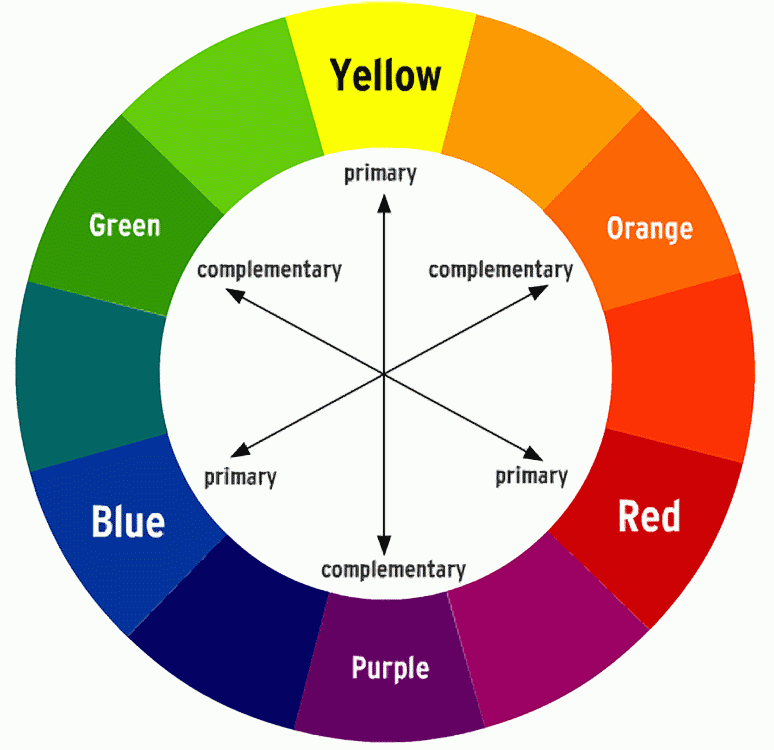
In Jordan's Photoshop class, we worked on some concept art for our cities. I drew out a few different designs which I have published in my last Invisible Cities post. As well as this, we went over colour theory, which was very interesting. I wanted to make a note on here of what we learnt about colour so I'll always have something to refer back to.

We learnt about the basic colour wheel, and we went over hues, tints, tones and shades. What interested me the most was how to pick your colours using different methods. You can pick your colours based on whether they are complementary or not. By doing this, you'll be able to make your art pieces pop a bit more: for example, if you have a red environment and use blue shadows, it'll look a lot more vibrant and interesting, compared to just using a darker red for the shadow (which is what I usually do!)


Toolkit - Timing in Animation

In Nat's lesson last week we worked on timing. I wasn't in this lesson, but I managed to gather enough information to understand what I needed to do! In the GIF below are the examples I've made that I'm pretty sure was covered in Nat's class.


The top ball is travelling at a constant speed from one side of the screen to the other, whereas the one below it eases in, speeds up, and then slows down to ease back out again. To ease it in, you need to include more frames at the beginning, then do less to make it speed up. The class then applied this logic to a pendulum swinging back and forth.


In this pendulum example, you can see that the ball is swinging at a constant speed, and it doesn't really look that natural at all. However, if you apply the 'ease in, ease out' principle to it, and add in an arc to give it a more natural swing, the whole animation suddenly looks a lot smoother:


It was interesting to apply this logic to different scenarios, and I can think of lots of different ways in how it can be helpful in animation, such as a car speeding up and slowing down, a ball, or other objects. Hopefully I've accurately covered all I missed in that lesson, this is as much as I could gather from talking to Nat, my classmates and also looking at their blogs!

Toolkit - Perspective, Composition, Rule of Thirds

In one of Jordan's earlier classes we worked on perspective and composition. I wasn't well for the class but I've caught up looking at other people's blogs and looking at the material from the lesson! This blog is about a month late but I'm finally trying to prioritise getting my backlog of work all uploaded and finished, so expect a lot of previous stuff in the next few days!

At first I worked on perspective. I've already done the perspective exercises traditionally, but I've also completed some digital ones too. Here's what I've done to practice:


I've also researched on making a good composition which involves the rule of thirds. The teaching is that by drawing a 3x3 grid on your page you can use the lines as a guide to create a 'good' composition. The horizon is meant to sit on the lower horizontal line, and points of interest are meant to fall on any of the lines (or at least close to where the lines are, or where they intersect). I've included a photograph as an example below.


Monday, 6 November 2017

Toolkit - Maya Alley Texturing

Today in Simon's class we worked on the previous alley model we had made and began to set it up for texturing. I didn't have my finished file with me for the lesson so I used an unfinished one which is why it looks a little scruffy!


We learnt how to properly apply materials onto surfaces, and how to use the UV editor to edit the texture so it isn't stretched or warped. By doing this, when it comes to putting the final texture on, it'll be a lot easier as we've already smoothed out all the problems. We will move on to actual texturing next week!

Wednesday, 1 November 2017

The 'What If?' Metropolis - Digital Thumbnails 39-76

Here's all of the thumbnails I've done so far! Will definitely be more to come soon, I'm loving all of the ideas I have so far and can't wait to keep developing them.


The 'What If?' Metropolis - Online Greenlight Review

Here is my OGR! I'm so pleased I managed to reach the required amount of thumbnails. It's crazy that I've managed to do 76 in just a week! I couldn't even reach 100 over the five weeks of Invisible Cities so it's such a big improvement. I didn't quite reach 1000 words on my travelogue, and I think it does need a bit more polishing. At least it gives a basic idea of what I want the city to be like. I've named the city Alptraum, which is German for 'nightmare', and I quite like the name, although I'm going to keep looking for better ones so it may change later!