Sunday, 15 October 2017
Friday, 13 October 2017
Toolkit - Monster Orthographic Views
Today in Simon's class we carried on with our monster designs, taking the one we did in Illustrator into Photoshop. We were shown how to do the orthographic views for a character, and I had fun making mine in different views. Unfortunately, because my Beatnik monster wasn't too detailed, the orthographic views don't vary too much. Here is the finished product:
And also a Beatnik bunny because I finished a little early!
Toolkit - Follow Through and Overlapping Action
In Nat's lesson today we worked on some more principles of animation: follow through and overlapping action. During the class we had to build on the ball we made last lesson to give it a tail/limbs, and then make those extra features move along naturally with the ball. Nat suggested doing a rabbit ball with ears that flop, or a cat with a tail. I decided to do a rabbit and wanted to make it a bit more detailed than a ball so I started with a new Flash document and sketched out a basic cartoon bunny. Here is my rough animation, where the bunny hops up and down and follows the arcs I've drawn in:
As you can see, the ears move more independently from the body, which is called overlapping action. When the rabbit stops and the ears keep moving, that's called follow through. It's generally used for things like hair and clothes on people, as after they stop moving, the hair/clothes naturally keep on going even though the person wearing them has stopped. After finishing my rough GIF, I used the rest of the lesson to neaten it up. I started with a 1920x1080 canvas but I realised I wasn't using a lot of the space, so I made it a bit smaller. Here's my finished product:
I really enjoyed this lesson, especially because it had rabbits in it! I liked recapping follow through and overlapping action, since the last time I went over the principles of animation was about a year ago! It was also nice to do a more detailed animation, building on from the skills we learnt with the bouncing balls.
Thursday, 12 October 2017
Invisible Cities - Zenobia Influence Maps
Here are the interior and exterior influence maps for Zenobia. I want to go with Chinese and Japanese architecture, but I've also pulled a few influences from Thai and Korean architecture too. For the interior of the houses I want it to look quite cluttered and home-like, and this wasn't really present in Japanese interior design, so I was glad to look at a few different influences to get the kind of feel I was looking for.
Film Review - 2001: A Space Odyssey
2001: A Space Odyssey (1968), by Stanley Kubrik, is a bold and unusual film that uses incredibly realistic acting and effects from before the time of CGI. The story follows a mysterious monolith through space and time, as well as focusing on modern artificial intelligence going rogue - something humans have always feared.
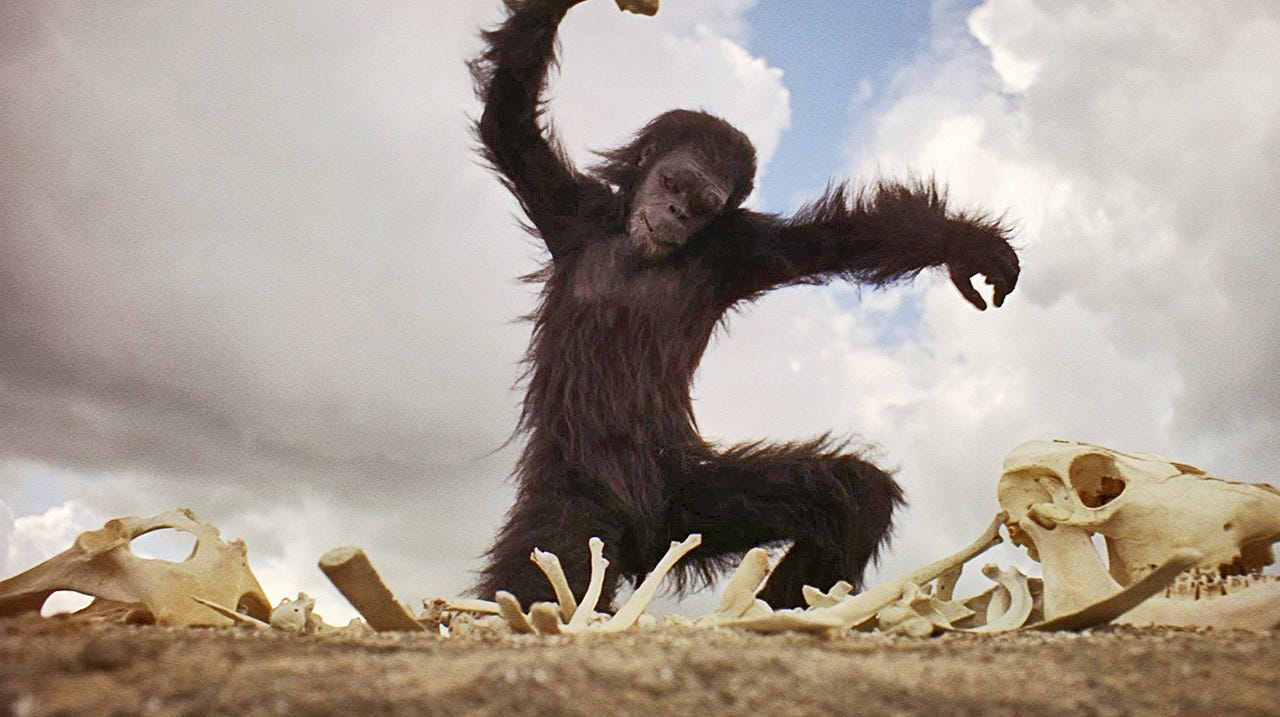
Often described as an "unconventional plot" (Fox, 2011), the film may, at first, be a bit confusing for some when it opens up in the pre-human era, where ape-like creatures discover the monolith for the first time. The apes gradually evolve, discovering new tools and methods of survival. Although this beginning is wildly different from the rest of the film visually, (mainly because it's set on Earth instead of space) the picture is absolutely stunning, as are the scenes to come.
![]() |
| Fig. 1 |
Directly following the ape scene, the viewer is launched into the future where the monolith has been found in a crater on the moon. The story then continues to fast-forward to 18 months in the future, where a mission has been launched to Jupiter, the planet where the monolith's strange signals are heading towards. However, on this mission the artificial intelligence computer that controls the ship, known as HAL 9000, malfunctions and become creepily human-like, as well as cruel and violent. After HAL murdering four of the crew members on the ship, it is up to the remaining member, Dave, to shut off the AI for good. Dave succeeds in this and continues his mission to Jupiter where he finds an even bigger monolith. From there we are launched into an incredible light show which ends with Dave in a hotel room, quickly ageing in an eerie way, before becoming immortal in space.
The film isn't fast-paced: in fact, it's exactly the opposite. Kubrick takes his time to make beautiful scenes, which makes the movie feel like a work of art rather than a film. Although the story is, at times, hard to understand, Kubrick more than makes up for it with the stunning visuals. The story in 2001 is Kubrick's own; he doesn't embellish it or make it more 'mainstream' to please other people, and that is probably a big contribution to the success of the film. It isn't made to conform to other people's standards, it's made to stand out and be different.
![]() |
| Fig. 2 |
Kubrick has been more than meticulous about the film's appearance. He often uses symmetry and one-point perspective to make his shots look amazingly balanced. Not only this, but the use of music in the film really adds to it, using a range of classical pieces to describe different atmospheres. The music also makes up for the lack of speech as "the first spoken word is almost a half hour into the film, and there's less than 40 minutes of dialogue in the entire film" (Dirks, no date). Although the characters don't say much in the film, it's still obvious what they're doing and why, and this is all described through set design, acting, costume and music. It's amazing how Kubrick has managed to make a scene 'talk' without actually having any character physically speaking.
![]() |
| Fig. 3 |
At the end of the film, it is a lot more confusing, especially during the psychedelic scene that lasts for just under 10 minutes, followed by the slightly puzzling scene in the hotel/bedroom. "The film did not provide the clear narrative and easy entertainment cues the audience expected. The closing sequences, with the astronaut inexplicably finding himself in a bedroom somewhere beyond Jupiter, were baffling." (Ebert, 1997). Even though it can be difficult to understand, one of the main points is that it really makes you think about the story, what it means, and why the film was made in this way. 2001 really pulls attention to itself not only by its amazing visuals, but also by its unconventional and original story, which is something that not many films can do.
![]() |
| Fig. 4 |
Bibliography
Fox, K (2011). "My favourite film: 2001: A Space Odyssey". In The Guardian [online]. Available at: (https://www.theguardian.com/film/filmblog/2011/dec/12/favourite-film-2001-space-odyssey)
Dirks, T (no date). "2001: A Space Odyssey (1968)". In Filmsite [online]. Available at: (http://www.filmsite.org/twot.html)
Ebert, R (1997). "2001: A Space Odyssey". In Roger Ebert [online]. Available at: (http://www.rogerebert.com/reviews/great-movie-2001-a-space-odyssey-1968)
Illustration List
Fig. 1 - https://cdn-images-1.medium.com/max/2000/1*v3Fxrk0rzkuyD_R0VyhBVA.jpeg
Fig. 2 - https://nonamemovieblog.files.wordpress.com/2012/04/2001-dead-room.jpg
Fig. 3 - https://i.pinimg.com/originals/68/e5/d7/68e5d7737321931f486530ee5832d2c3.jpg
Fig. 4 - https://cmsplatypus.gothamist.com/gothamistgallery/2017/3/21/f3c592375img_0018-13-jpg.jpeg
Film Review - King Kong
King Kong, directed by Merian Cooper in 1933, is definitely an interesting watch. The behaviour of society at the time is captured in this film very well; the sexism and racism is very prominent. The general plot of the film is one that most people are probably familiar with: Anne, the main protagonist has captured the eye of the giant ape King Kong, who is then captured and taken to New York City where he wreaks havoc until killed. What is more interesting than the plot, however, is the way the characters act, and more importantly, why.
| Fig. 1 |
As stated in many reviews, "modern viewers will shift uneasily in their seats during the stereotyping of the islanders in a scene where a bride is to be sacrificed to Kong" (Ebert, 2002). Not only this, the stereotypy of Anne as a screaming damsel in distress is also something that is quite unsettling to a modern audience. It is interesting to see how stereotypes have changed, and also slightly horrifying to see how to world used to be stuck in rigid views of how specific genders or races should act.
Despite the blatant sexism and racism in the film, it was still a ground breaking picture of its time, and has now spawned many sequels and remakes. Described as "ahead of its time" (Haflidason, 2001), the special effects were something that not many people had seen before. In 1933 the film industry was still developing, and technology was moving slowly forwards. Although we may find it silly now, it was a film that was so life-like back then that it had people on the edge of their seats.
![]() |
| Fig. 2 |
![]() |
| Fig. 3 |
Bibliography
Ebert, R. (2001). "King Kong". In: RogerEbert [online] Available at: (http://www.rogerebert.com/reviews/great-movie-king-kong-1933)
Haflidason, A. (2002). "King Kong (1933)". In BBC Movies [online] Available at: (http://www.bbc.co.uk/films/2001/01/30/king_kong_1933_review.shtml)
Dirks, T (no date). "King Kong (1933)". In filmsite [online] Available at: (http://www.filmsite.org/kingk3.html)
Illustration List
Fig. 1 - http://www.attitudedesign.co.uk/sites/default/files/wp-content/uploads/2011/11/KingKongPoster.jpg
Fig. 2 - https://thenypost.files.wordpress.com/2017/03/kong1933a.jpg?quality=90&strip=all&strip=all
Fig. 3 - https://ianfarrington.files.wordpress.com/2016/07/kk1933.jpg
Life Drawing
Some of my favourite life drawings from yesterday. Definitely need to work on taking better pictures of these!
Subscribe to:
Comments (Atom)


